The Arquebus (Handgun) in 1573 – Range, Wounds and Tactics
The Arquebus in 1573: Range, Wounds and Tactics
The haakbus, or arquebus, was one of the most feared weapons on a sixteenth-century battlefield. Its solid lead ball could break bone and kill at close range. Yet the weapon was slow to reload, difficult to aim precisely and vulnerable to rain, wind and a sudden charge. In 1573, an arquebusier was most dangerous when he fought as part of a disciplined group, supported by pikemen and using the ground to his advantage.
What was a haakbus?
The word haakbus is related to arquebus or harquebus, but period sources do not always use firearm names consistently. Weapons differed in weight, barrel and calibre. The lighter caliver, common among troops in the Low Countries, was distinct from heavier arquebuses and muskets.
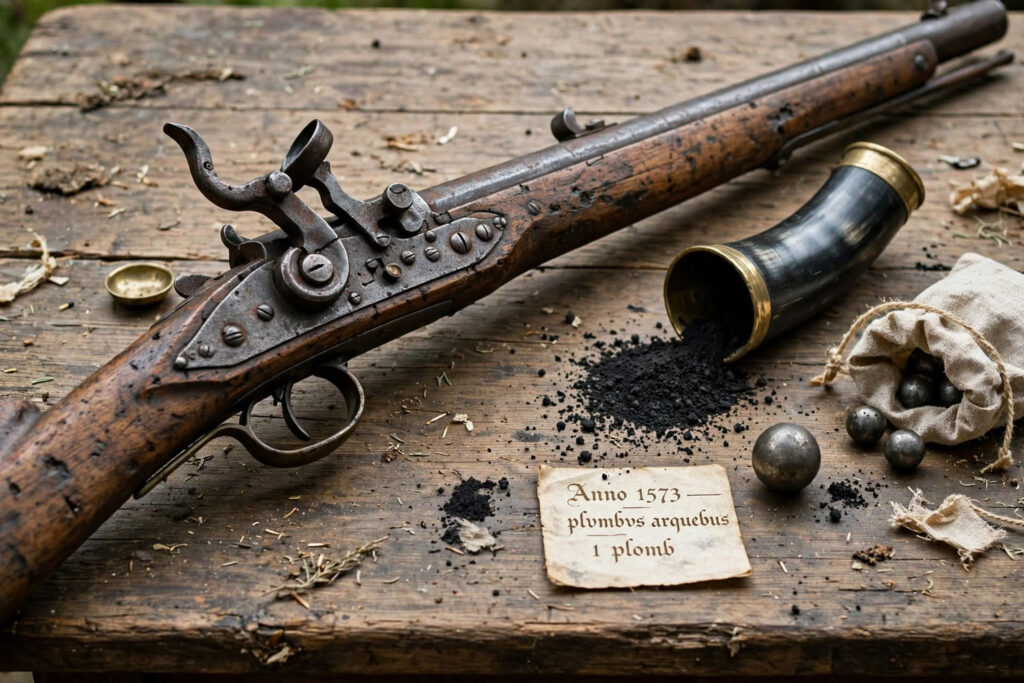
A matchlock arquebus was loaded through the muzzle with powder and a round lead ball. The shooter used a smouldering match held in a spring-loaded arm: pulling the trigger lowered it into the priming pan and ignited the main charge. A caliver could weigh about 4–4.5 kilograms and fire a lead ball of roughly 20 grams. Heavier arquebus balls could weigh considerably more. These are useful period comparisons, not specifications for every gun carried in 1573. [1]
The firing process took time. A soldier had to measure powder, load the ball, ram it down the barrel, prepare the pan and keep the match alight. Under battlefield conditions, reloading could take around two minutes. A shot therefore mattered most when it was fired at a useful moment and into a target the shooter could actually hit. [1]
How far could it shoot effectively?
A ball could travel much farther than a soldier could reliably aim. Maximum range and effective battlefield range are not the same.
A cautious estimate for aimed or controlled fire against troops is roughly 30–40 metres. At that distance a shooter had a better chance of hitting a man-sized target; against an armoured opponent, a very close shot might be needed. A 1590 military writer, Sir John Smythe, treated about 40 yards—approximately 37 metres—as the practical limit for using a harquebus. Smythe was writing in England and arguing about the relative value of firearms and bows, so his figure is a contemporary opinion, not a universal rule for every army. [2]
Experimental tests of early firearms support the caution. The tested weapons were a mixed group dating from 1571 to the eighteenth century, rather than a single standard 1573 arquebus. The tests found poor accuracy in smoothbore guns and rapid loss of a spherical ball’s energy over the first tens of metres. At longer distances, a firearm could still hit a dense formation, but it was not a dependable precision weapon. [3]
For a battlefield reconstruction, 30–50 metres is a reasonable working range for concentrated fire against a body of troops. Individual shots at moving targets would be less reliable. Beyond that, the ball might still wound or kill, but the captain could not count on each shot finding its mark.
What wounds did the ball cause?
A lead ball was heavy and blunt. A close hit could punch through flesh, crush tissue, shatter a limb bone or damage the chest and abdomen. Depending on where it struck, the ball might pass through the body or remain lodged inside. Severe bleeding, fractures and lasting disability were common dangers; a wound that did not kill immediately could still become fatal through later complications.
The French surgeon Ambroise Paré devoted a 1545 treatise to wounds caused by arquebuses and other firearms. His later writings discuss fractures, damaged bone, gangrene and tissue death, showing how difficult such injuries were to treat with sixteenth-century surgery. [4]
A firearm was not guaranteed to defeat armour. A well-made breastplate could protect its wearer, especially as the ball lost energy with distance. Some armour was tested by firing at it. The result depended on the weapon, the shot, the distance, the quality of the plate and the angle of impact. “A bullet could pierce armour” and “armour could stop a bullet” are both too broad as general rules.
How did a captain arrange his men?
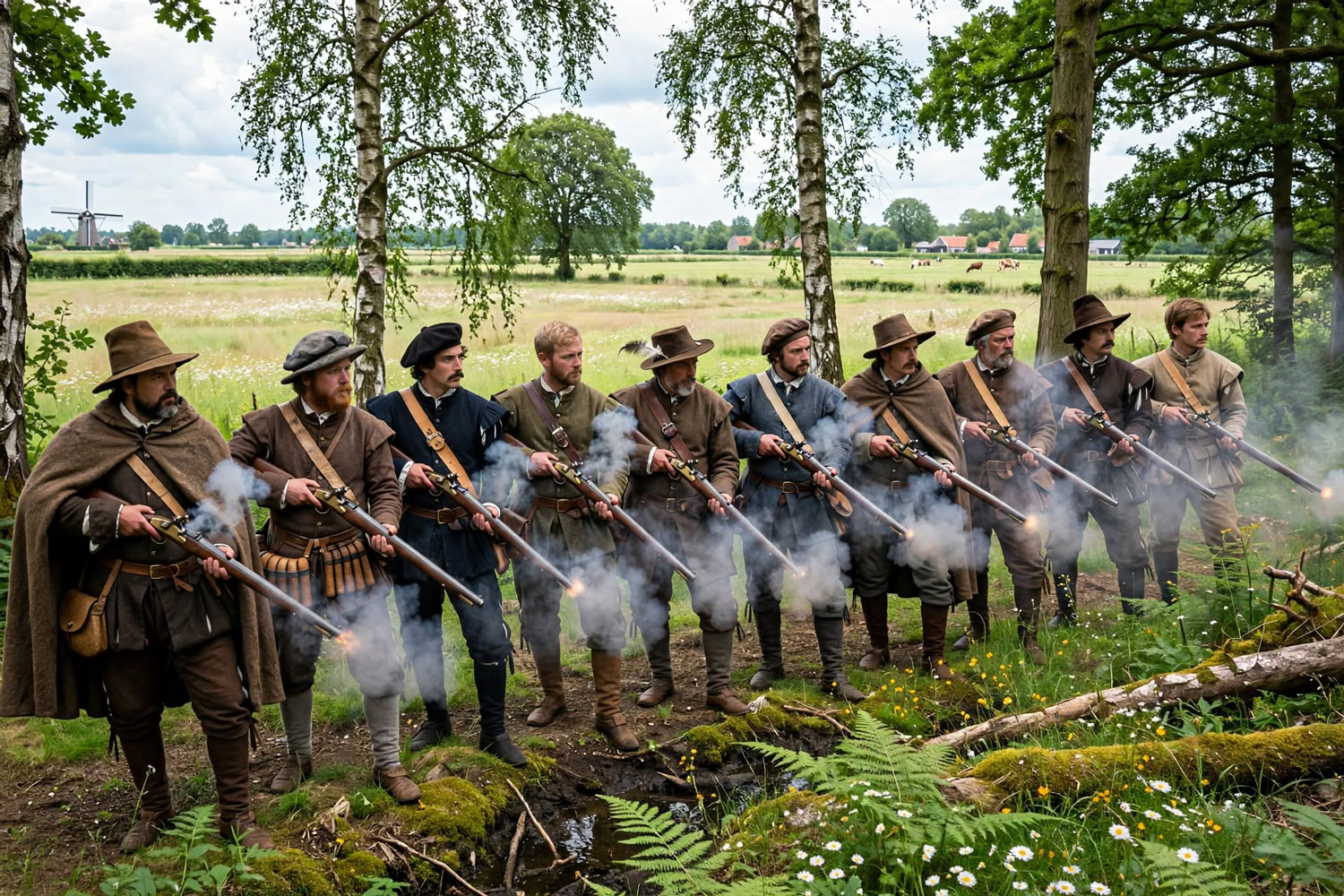
A captain did not send a line of arquebusiers out to face cavalry alone. In the open field, firearm troops operated close to the pike formation that protected them. In the Dutch insurgent army, firearms could form wings beside the pikemen; when cavalry threatened, shooters sought cover among or behind the pikes. Where hedges, ditches and other obstacles reduced the risk of a mounted attack, lighter firearm troops could move forward in looser groups and harass the enemy. [1]
A States of Holland order from August 1573 provides a striking, near-contemporary example of how heavily armed some companies could be: it prescribed 18 men with sword and buckler, 20 pikemen and halberdiers, and 112 calivermen. That order came after the Battle of Heemstede, so it does not prove the exact composition of the relief army on 9 July. It does show why a captain needed pikes and other close-combat weapons to support so many shooters. [1]
The captain’s practical task was to keep his shooters within reach of that protection, use the ground, and prevent premature or wasted firing. For the States’ troops, the overall arrangement of the battle formation belonged to senior officers, including the sergeant-major; a company captain maintained order in his own unit within that larger formation. [5]
No continuous volley drill should be assumed for 1573
The regular, carefully drilled volleys often associated with the Dutch army belong to later reforms. For the insurgent troops of the 1570s, soldiers with firearms might alternate their shots, but they did not yet use the standardized, continuous firing system developed in the 1590s. A captain could order groups to fire, but it would be misleading to show every 1573 company executing the later Dutch countermarch as a routine manoeuvre. [1]
Mounted arquebusiers were a separate arm. Diego García de Palacio’s 1583 military manual describes them as mobile troops that could move to a useful position, support the main body and attack an enemy flank. Because this manual postdates Heemstede and concerns mounted shooters, it is evidence for a related tactic—not proof of the exact deployment at the battle. [6]
What this means for the Battle of Heemstede
The arquebus was powerful at close range, especially when several shooters could fire into a dense target. Its battlefield value came from the combination of fire, pikes, discipline and terrain. A captain needed to bring his men close enough for their shots to count while keeping them close enough to the pikes to survive the enemy’s approach.
This general practice helps explain how arquebusiers could be used around roads, hedges and ditches near Heemstede. It does not, by itself, establish exactly where particular shooters stood on 9 July 1573, how many were present, or whether they fired from a specific point along the Herenweg. Those details must be established from the battle’s own sources.
Sources
- Petra Groen (ed.), Olaf van Nimwegen, Adri van Vliet and Louis Sicking, The Eighty Years War: From Revolt to Regular War, 1568–1648 (Leiden University Press, 2019), chapter 3, especially pp. 121–129. The discussion of the August 1573 company order cites Nationaal Archief, Handschriften Derde Afdeling 478 (WvO 11597). Publisher’s book page.
- Sir John Smythe, Certain Discourses Military (1590), discussion of the practical use of harquebuses; see J. R. Hale, ed., Certain Discourses Military (Folger Shakespeare Library/Cornell University Press, 1964), pp. 86–87. Digitised text and catalogue.
- Peter Krenn, Paul Kalaus and Bert Hall, “Test-Firing Early Modern Small Arms,” Material Culture Review 42 (1995). Read the article.
- Ambroise Paré, La Méthode de traicter les playes faictes par hacquebutes et aultres bastons à feu (Paris, 1545). Bibliothèque nationale de France catalogue record. See also I. M. L. Donaldson, “Ambroise Paré’s accounts of new methods for treating gunshot wounds and burns,” Journal of the Royal Society of Medicine 108 (2015). Open-access article.
- Ricardo González Castrillo, “La formación de escuadrones en los tratados militares españoles de la decimosexta centuria,” Revista de Historia Militar 133 (2023), pp. 37–74. University Complutense research record.
- Diego García de Palacio, Diálogos militares (Mexico, 1583), fol. 177v. Digital facsimile record.
The illustrations on this site are modern reconstructions, not historical images. Copyright Ted Nuyten en Thibauld Nuyten