Lope de Acuña y Avellaneda – Spanish General
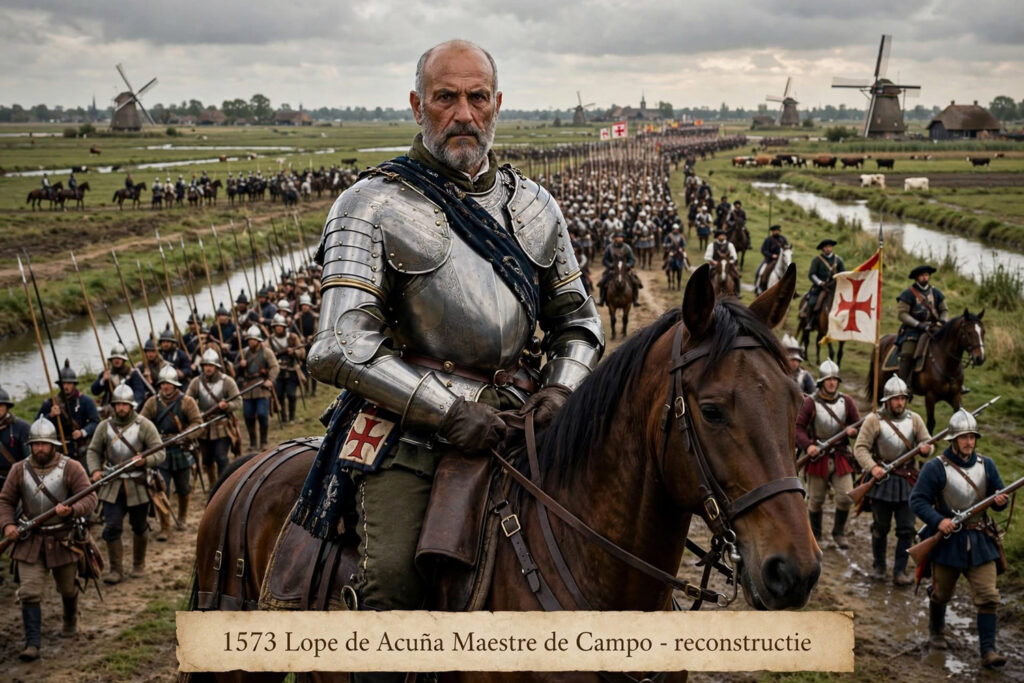
Lope de Acuña y Avellaneda (1529–1573) was a Spanish nobleman and military officer in the service of Philip II. He pursued a career as a cavalry commander and military governor in Italy and the Netherlands. His principal contribution to the siege of Haarlem was leading the reinforcements brought from Italy in 1573. [1, 2]
Acuña came from a noble family in Valladolid, related to the counts of Buendía. His parents were Juan de Acuña and Constanza de Avellaneda. His career took him to the Spanish possessions in northern Italy, where he held administrative and military positions in Pontestura, Valenza, Mortara and Alessandria. He thus combined experience in governing fortified towns with the command of troops. [1]
In the Netherlands, he served under the Duke of Alba. His position is clearly documented in Sancho de Londoño’s contemporary account of the campaign of 1568. Londoño describes him as teniente de general de la caballería ligera: lieutenant-general of the light cavalry. During the pursuit of William of Orange in November 1568, Acuña was given command of 700 cavalrymen. His orders were to support the towns along Orange’s line of march and attack enemy troops that fell behind or marched separately. Londoño also records that Orange kept his cavalry and infantry so closely together that these attacks achieved little. [3]
In the spring of 1573, Acuña received a new assignment: to lead reinforcements from Italy to the Netherlands. Lope de Figueroa had initially been selected to command the expedition but cited health problems. Acuña took his place. This appointment is discussed in research drawing on correspondence exchanged in March 1573 between Figueroa, Luis de Requesens and Philip II. [4]
The reinforcements comprised approximately 5,000 men, organised into 25 companies. Drawn from the Spanish infantry stationed in Italy, they strengthened the royal army during the final phase of the siege of Haarlem. Pieter Corneliszoon Hooft likewise records that Acuña had brought two regiments from Italy. His importance to the Haarlem campaign therefore lay primarily in the arrival of a substantial body of fresh troops under his command. [2, 5]
His personal life was also connected with the Netherlands. With Isabel de Lompré, he had a daughter, Constanza, who was born in Tournai in 1570. Recent archival research identifies her as a child born outside marriage. In his will, dated 27 April 1573, Acuña appointed his brother Pedro as her guardian. Constanza later married Diego Sarmiento de Acuña, the future Count of Gondomar and Spanish ambassador to England. [1]
Acuña died in Haarlem in 1573. In his account of events later that year, Hooft refers to him as already deceased. A catalogue description of a letter in the Salazar y Castro collection gives 29 July 1573 as his date of death. This precise date remains provisional, however, because the original document has not been examined in this research. The sources consulted do not establish a reliable cause of death. [5, 6]
His involvement in the Haarlem campaign is documented, but his personal participation in the Battle of Heemstede on 9 July 1573 has not been confirmed. The most defensible description of his role is therefore: Spanish cavalry commander and leader of the reinforcements brought from Italy in 1573.
Sources
- Esperanza Mó Romero and María Estela Maeso Fernández, “Constanza de Acuña y Avellaneda…”, Clepsydra 22 (2022), particularly pp. 54–59. Family background, Italian appointments, daughter and testament.
- Raymond Fagel, Protagonists of War (2021), chapter on Francisco de Valdés. See also the open-access edition. Reinforcements sent from Italy in 1573.
- Sancho de Londoño, Gedenkschrift over de krijgsbedrijven van 1568, Spanish text with Dutch translation, particularly pp. 82–85. Acuña’s cavalry command during the campaign of 1568.
- Doctoral thesis available through Tesis Doctorals en Xarxa. Discussion of Acuña’s appointment in place of Lope de Figueroa, citing correspondence from March 1573.
- Pieter Corneliszoon Hooft, Nederlandsche Historiën, Book VIII. References to the regiments Acuña brought from Italy and to his death.
- Real Academia de la Historia, Salazar y Castro collection catalogue, A-69, fols. 307–307v, inventory no. 10593. Letter description giving 29 July 1573 as his date of death; original document not examined.
The illustrations on this site are modern reconstructions, not historical images. Copyright Ted Nuyten en Thibauld Nuyten