La Goleta (1573): The Spanish Fortress That Cut Haarlem’s Lifeline
How a Spanish stronghold on the Fuikvaart helped turn the Siege of Haarlem into a battle for survival.
Haarlem’s Last Lifeline
In the spring of 1573, the Dutch city of Haarlem was fighting for its survival. Surrounded by Spanish forces under Don Fadrique Álvarez de Toledo, the son of the Duke of Alba, the city had endured months of siege, bombardment and increasingly desperate shortages.
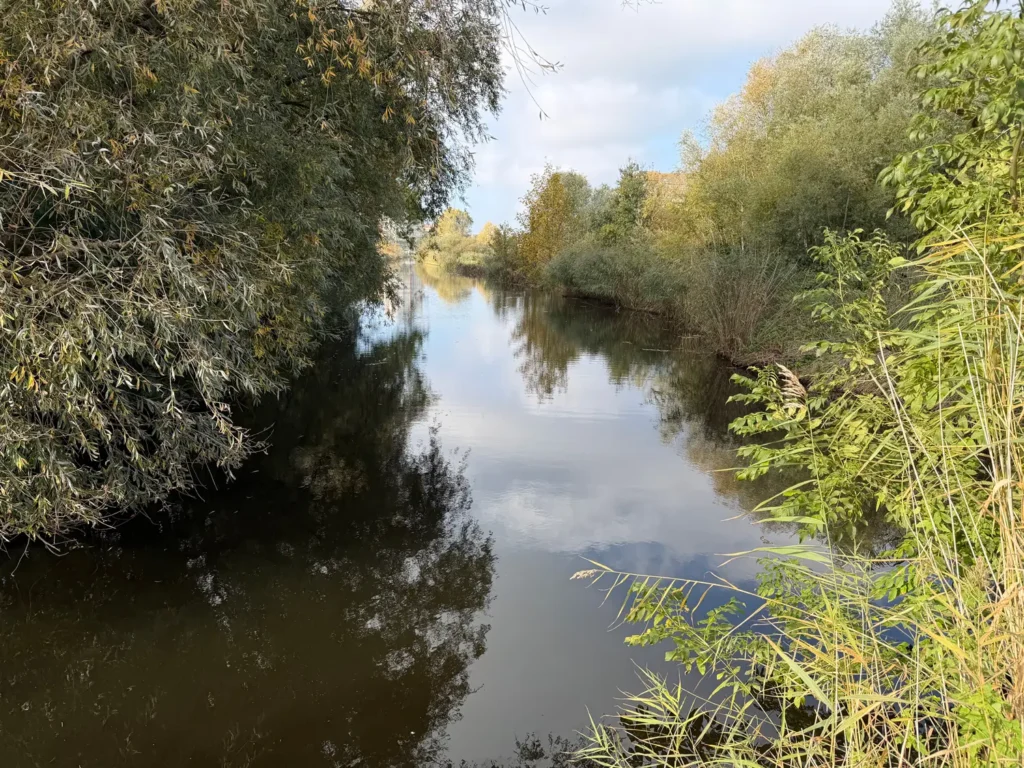
Yet Haarlem still had one vital connection to the outside world: the Fuikvaart, a waterway linking the city to the Haarlemmermeer.
Through this narrow route, boats could bring food, gunpowder, weapons and other essential supplies into the besieged city. The waterways also offered a means of communication with the forces of William of Orange. As long as supplies could reach Haarlem, its defenders had a chance of continuing their resistance.
For the Spanish commanders, the strategic conclusion was clear. Capturing the city required more than artillery and repeated assaults on its walls. Haarlem’s remaining supply routes had to be severed. At the entrance to the Fuikvaart, the Spanish established a powerful field fortification known as La Goleta. Its purpose was straightforward: to close Haarlem’s lifeline.
The Fuikvaart: A Strategic Waterway
In 1573, the landscape south and east of Haarlem looked very different from today. The Haarlemmermeer was still an extensive inland lake, surrounded by waterways, marshes and low-lying agricultural land. Ships and small boats were essential for transporting goods, soldiers and military supplies.
The Fuikvaart connected the area south-east of Haarlem with the Haarlemmermeer. Through the lake, rebel-controlled waterways offered connections towards Leiden and other territories supporting William of Orange.
During the winter of 1572–1573, supplies had even been transported across frozen waterways and flooded terrain. When the ice disappeared, boats became increasingly important.
The Spanish siege had effectively isolated Haarlem by land, but the city could not be completely starved into submission while supplies continued arriving over water. Control of the Fuikvaart was therefore not a minor tactical objective. It was central to the entire siege.
Whoever controlled the entrance to the Fuikvaart could largely determine whether Haarlem received the supplies it needed to survive.
The Construction of La Goleta
At the end of March 1573, Spanish forces under Don Fadrique tightened their control over the Haarlemmermeer. On 29 March, a Spanish fleet under the Count of Bossu entered the lake after an opening had been made through the Hoogendijk.
The arrival of Spanish vessels made it possible to establish a much more effective blockade. Near the entrance to the Fuikvaart, on its southern bank, Spanish troops constructed the fortification known as La Goleta. The position was carefully chosen.
From La Goleta, Spanish troops could threaten boats attempting to enter the Fuikvaart from the Haarlemmermeer. Artillery could cover the surrounding waterways, while soldiers protected the position against attacks from land or water.
The fort also helped protect Spanish naval operations on the lake. La Goleta was therefore more than a simple defensive earthwork. It was an essential component of a coordinated military blockade.
What Did La Goleta Look Like?
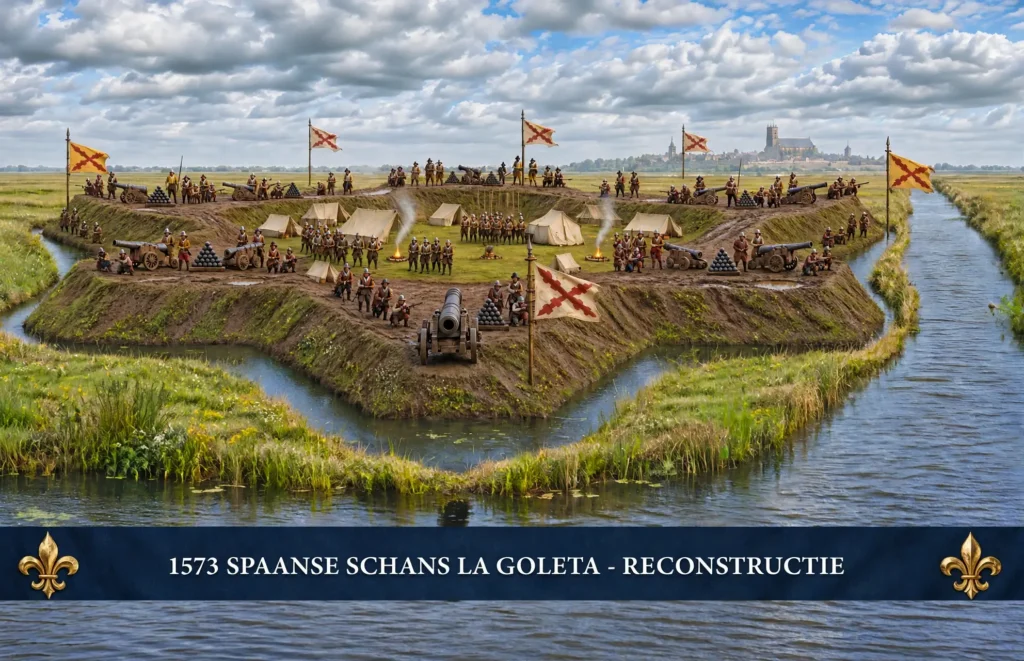
La Goleta was an earthwork field fortification, or schans, constructed to provide protected positions for infantry and artillery.
Such fortifications generally consisted of earthen ramparts, defensive ditches and platforms or positions for cannons. Their shape depended on the terrain, available manpower and tactical requirements. The exact dimensions, configuration and number of guns at La Goleta have not been conclusively established.
A historical reconstruction may depict a bastioned, star-shaped earthwork with artillery overlooking the waterway, but its precise appearance remains a matter of interpretation. What is beyond doubt is the strategic importance of its location.
The Fight to Keep the Waterway Open
Haarlem’s defenders understood the danger immediately. When the Spanish began building La Goleta, the city’s commander, Wigbolt Ripperda, attempted to interfere with its construction.
A Haarlem galley carrying volunteers was dispatched towards the position. However, Spanish forces had already made substantial progress, and the operation failed to prevent the fortification from being established. Further attempts were made to challenge the Spanish position.
On 9 April 1573, approximately one hundred vessels belonging to the forces of William of Orange approached the Fuik area. The defenders of Haarlem hoped that this naval operation might reopen communications with the outside world.
However, strong winds, Spanish resistance and artillery fire from La Goleta prevented a decisive breakthrough. The waterway remained under Spanish pressure.
Nevertheless, the blockade was not completely watertight. Small quantities of gunpowder and other supplies occasionally reached the city through dangerous alternative routes. Such successes demonstrated the determination of Haarlem’s defenders, but they could not replace a reliable supply system.
Rustenburg: The Struggle Along the Fuikvaart
La Goleta did not operate in isolation. Further along the Fuikvaart stood Rustenburg, a fortified position that became the scene of repeated fighting.
The struggle for Rustenburg reflected the importance of controlling the approaches to Haarlem. During April and May 1573, Spanish troops and the city’s defenders repeatedly contested the area.
One particularly violent engagement involved Jérôme Tseraerts, an officer fighting for the Dutch Revolt. During an action to support the defenders of Rustenburg, Tseraerts was injured when gunpowder accidentally ignited.
These engagements demonstrate that the battle for Haarlem was not confined to the city walls. The surrounding waterways, roads, small forts and agricultural fields formed an interconnected battlefield. La Goleta and Rustenburg occupied important positions within this struggle.
26 May 1573: The Battle of the Haarlemmermeer
The decisive naval confrontation took place on 26 May 1573. A rebel fleet under Marinus Brandt attempted to challenge Spanish control of the Haarlemmermeer and relieve the pressure on Haarlem.
The Spanish fleet, commanded by the Count of Bossu, was supported by ships from Spanish-aligned Amsterdam. Although the rebel fleet reportedly possessed a numerical advantage, the Spanish vessels were better equipped for the engagement, and favourable winds assisted their operations.
The Spanish won the battle. The defeated rebel vessels withdrew towards the Kaag and Oude Wetering, where further ships were captured. For Haarlem, the consequences were devastating.
The loss of control over the Haarlemmermeer made it increasingly difficult to restore the city’s supply lines.La Goleta remained part of the Spanish system of control over the Fuikvaart. The city was now moving towards a humanitarian catastrophe.
Hunger Becomes a Weapon
By June 1573, the defenders and civilian population of Haarlem were suffering severely from shortages. Food was increasingly scarce, ammunition supplies were limited, and the prolonged siege had exhausted the city’s resources.
The contemporary Haarlem diarist Willem Janszoon Verwer recorded the worsening hunger and the many attempts to obtain provisions. The Spanish strategy was achieving its objective.
Haarlem had resisted direct military assault for months, but without adequate supplies, continued resistance was becoming impossible. The loss of the Fuikvaart as a dependable supply route had contributed directly to this crisis.
La Goleta did not single-handedly defeat Haarlem. The city’s fall resulted from the combined effects of the land siege, naval blockade, military losses and increasing starvation.
However, La Goleta was one of the strategically important positions that enabled the Spanish to transform the siege into an effective blockade.
The Fall of Haarlem
After approximately seven months of resistance, Haarlem surrendered on 12 July 1573. The surrender ended one of the most determined episodes of urban resistance during the early Dutch Revolt.
The Spanish victory came at a considerable military and financial cost. For the inhabitants, the consequences were tragic. Following the surrender, numerous soldiers and civilians were executed despite expectations of clemency. The Siege of Haarlem became a symbol of both the brutality of sixteenth-century warfare and the determination of the Dutch rebels.
Yet behind the dramatic assaults, bombardments and battles lay a fundamental military reality. A city cannot continue fighting indefinitely without food, ammunition and supplies. At Haarlem, control of the surrounding water network proved decisive.
Historical Sources and References
[1] J. van de Capelle — Het beleg en de verdediging van Haarlem in 1572–1573, Volume III.
A historical account of the Siege of Haarlem, including the construction of the Spanish fortification La Goleta, the blockade of the Fuikvaart, its reported completion on 31 March 1573, and the unsuccessful attempt to reopen the waterway on 9 April 1573.
Read the historical account — Project Gutenberg
[2] Willem Janszoon Verwer — Memoriaelbouck: Dagboek van gebeurtenissen te Haarlem van 1572–1581. Edited by J.J. Temminck, 1973.
A contemporary eyewitness account of events in Haarlem during the siege. The diary documents military operations, food shortages, the deteriorating conditions within the city, and the events surrounding its surrender in July 1573.
Read the historical diary — DBNL
[3] Rijksmuseum, Amsterdam — Battle Between Dutch and Spanish Ships on the Haarlemmermeer, 26 May 1573. Hendrick Cornelisz. Vroom, c. 1629 or later.
A historical painting depicting the naval battle of 26 May 1573, when Dutch rebel forces attempted to regain control of the Haarlemmermeer, a vital supply route to the besieged city of Haarlem.
View the painting and collection record — Rijksmuseum
[4] Haarlemmermeermuseum — Slag: Zeeslag Geuzen en Spaanse vloot.
A historical overview of the naval battle on the Haarlemmermeer on 26 May 1573, the Spanish victory under the Count of Bossu, and the consequences for Haarlem’s supply lines and continued resistance.
Read the historical overview — Haarlemmermeermuseum
Historical note: The reconstruction of La Goleta’s appearance, dimensions, rampart height, and artillery positions is interpretative. The precise configuration of the original fortification has not been conclusively established by the sources listed above.
The illustrations on this site are modern reconstructions, not historical images. Copyright Ted Nuyten en Thibauld Nuyten