1573 William of Oranje
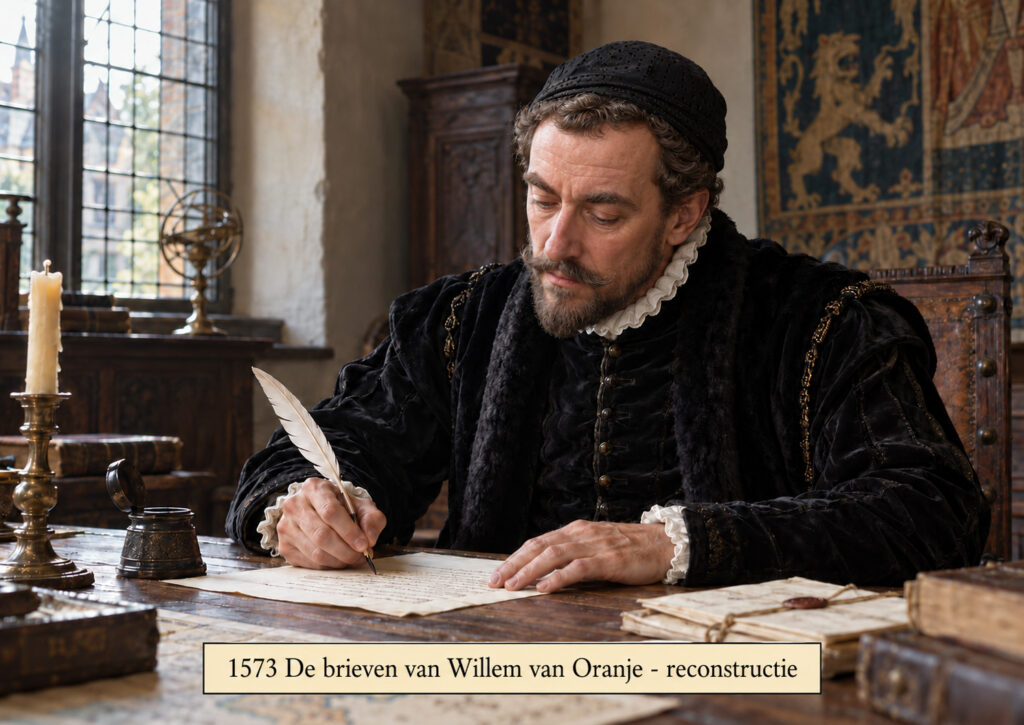
William of Orange (1533–1584) was Prince of Orange, Count of Nassau and the principal political leader of the Dutch Revolt against Philip II. He developed from a trusted servant of the Habsburg dynasty into the central figure of the resistance. During the siege of Haarlem in 1572–1573, he was responsible for organising assistance to the city.
William was born on 24 April 1533 at Dillenburg Castle, the eldest son of William of Nassau, known as William the Rich, and Juliana of Stolberg. His family was Lutheran. When his cousin René of Chalon died without legitimate descendants in 1544, the eleven-year-old William inherited the principality of Orange and extensive estates in the Netherlands. Emperor Charles V approved the inheritance on condition that William receive a Catholic education. The young prince moved to the court in Brussels, where he was prepared for a prominent position.
Initially, William served the Habsburg rulers as a nobleman and military commander. In 1559, Philip II appointed him stadtholder of Holland, Zeeland and Utrecht. In the years that followed, he increasingly opposed the centralisation of government and the persecution of Protestants. His position reflected both his views on freedom of conscience and his defence of established political rights. In the Council of State on 31 December 1564, he spoke against rulers who sought to impose religious belief on their subjects by force.
The crisis intensified after the Iconoclastic Fury of 1566. William refused the new oath of allegiance demanded of him, resigned his offices and departed for Nassau in April 1567. Under Fernando Álvarez de Toledo, Duke of Alba, his possessions in the Netherlands were confiscated. His eldest son, Philip William, was taken to Spain. From 1568 onwards, William launched military campaigns against royal rule in the Netherlands, but his initial campaigns failed to achieve a decisive breakthrough.
In 1572, the Revolt gained a more lasting foothold when several towns, particularly in Holland and Zeeland, declared their support for him. They again recognised him as stadtholder, initially still formally acting in the king’s name. William settled in Holland and used, among other locations, the Convent of Saint Agatha in Delft as an administrative centre. Maintaining cooperation between towns, commanders and foreign allies became an important part of his work.
During the siege of Haarlem, William of Orange was forty years old. His responsibilities consisted chiefly of organising troops, money, supplies and cooperation. The archival description of his letter of 17 June 1573, for example, records his request that Aernt van Dorp serve as an adviser to Willem van Bronckhorst-Batenburg, commander of the army intended to relieve Haarlem. This letter demonstrates his involvement in preparing assistance for the city.
The final relief attempt ended in a severe defeat on 9 July 1573, south of Haarlem, in the area of Heemstede and the Haarlemmerhout. Willem van Bronckhorst-Batenburg commanded the relief force; William of Orange did not personally take part in the fighting. The historian Koenraad Wolter Swart also emphasises that the prince had reservations about this final undertaking. His involvement in assisting Haarlem should therefore not automatically be equated with approval of every military decision. The defeat and Haarlem’s subsequent surrender damaged his standing, as he had repeatedly promised the city that relief would arrive.
Nevertheless, William continued to organise the defence of Holland. In a largely encrypted letter to his brother Louis of Nassau, dated 22 July 1573, he expressed his concern about Alkmaar. He considered holding that town essential to preserving the rest of northern Holland. The letter shows how quickly he turned his attention to the next threat after the disaster at Haarlem.
The year 1573 was also significant in William’s religious development. According to Swart, he joined the Reformed Church that autumn. He nevertheless continued to object to intolerance towards those of other beliefs. At the same time, he was unable to put his pursuit of toleration into practice consistently: Catholic property was confiscated under his authority, and public Catholic worship remained prohibited in the rebel-held territories of Holland and Zeeland.
In the following years, William sought cooperation between the provinces of the Netherlands. The Pacification of Ghent of 1576 briefly offered a prospect of achieving this. Growing hostility between Catholics and Calvinists, however, obstructed his pursuit of political unity and religious peace. His vision also encompassed the southern Netherlands; the eventual separation between North and South was not simply the fulfilment of a predetermined plan.
William married four times: to Anna of Egmond, Anna of Saxony, Charlotte de Bourbon and Louise de Coligny. These marriages connected him with influential noble families in the Netherlands, the Holy Roman Empire and France. His sons Maurice and Frederick Henry would later play important roles in the government and military affairs of the Dutch Republic.
In 1580, Philip II declared him an outlaw. William responded with his Apology, a political defence in which he justified his actions and fiercely attacked the king. On 10 July 1584, he was shot dead by Balthasar Gérard at the Prinsenhof in Delft. He was fifty-one. His importance lay above all in his ability to sustain the resistance despite military defeats, financial shortages and internal divisions. This role secured his enduring place in Dutch history as the “Father of the Fatherland”.
The principal sources consulted were:
- Anton van der Lem, Willem van Oranje — Leiden University.
- Koenraad Wolter Swart, Willem van Oranje en de Nederlandse Opstand 1572–1584 — DBNL, particularly the passages on Haarlem, military organisation and religion.
- National Archives of the Netherlands, Van Dorp family archive, collection 1.10.25, inventory number 1028, letter from William of Orange to Aernt van Dorp, 17 June 1573.
- Regional Archives of Alkmaar, A Secret Letter from William of Orange, 22 July 1573. Original: Royal House Archives, A02-723a-1.
- Museum Prinsenhof Delft, The Story of William of Orange.
The illustrations on this site are modern reconstructions, not historical images. Copyright Ted Nuyten en Thibauld Nuyten